Wastewater infrastructure resilience: Redefining sludge handling in Northern Europe

June 30, 2026

Table of Contents

The operational landscape for wastewater treatment plants (WWTPs) across Northern Europe is defined by increasingly stringent environmental mandates and shifting climate patterns. Municipal and industrial facilities face the dual pressure of achieving efficient nutrient removal to meet strict EU discharge standards while managing highly abrasive sludges under volatile flow conditions.

To address these modern infrastructure challenges, Kronoa Northern Europe OÜ has established its strategic hub in Tallinn, Estonia. By bridging local technical support with advanced European manufacturing, Kronoa delivers specialised fluid-handling architecture engineered to enhance process stability, eliminate unplanned downtime, and reduce the Total Cost of Ownership (TCO) in municipal and industrial wastewater applications.

The core operational challenges of Northern European WWTPs

Modern wastewater infrastructure, from regional networks to major facilities in Northern and Western Europe, operates under constant rheological and regulatory stress. Standard pumping assets frequently fail when subjected to the true demands of modern municipal waste streams.

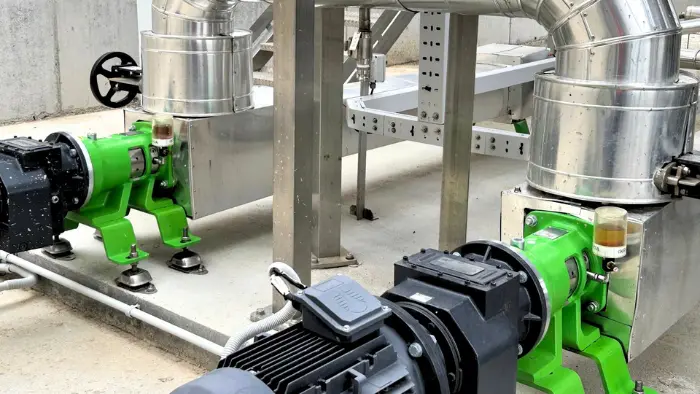
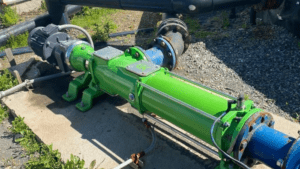
Two Kronoa Engineered Solutions progressive cavity pumps installed at a wastewater treatment plant (WWTP) for efficient sludge handling.

1. Regulatory compliance and nutrient removal

Fulfilling EU effluent criteria requires precise process control. Inefficient sludge transfer or erratic flow rates can disrupt stable biological processes in aerobic biological reactors, leading to non-compliance penalties, compromised treatment efficiency, or environmental spills.

2. Chronic equipment clogging and high solids

The composition of modern municipal wastewater has grown increasingly complex. The influx of wet wipes, fibrous rag, grease, and abrasive grit causes frequent blockages in standard submersible pumps, resulting in high maintenance costs and severe operational disruptions.

3. Sediment accumulation and stormwater surges

Climate-driven peak flows and stormwater events cause sudden capacity shifts, introducing large volumes of storm-related sludge and sediment into the plant. Over years of operation, this grit accumulates in lagoons, clarifiers, and grit chambers, drastically reducing active process volumes and hydraulic efficiency.

Value engineering: The premium line technical blueprint

To mitigate these systemic pain points, Kronoa Engineered Solutions developed the Kronoa Premium Line of progressive cavity pumps. Moving away from the common legacy practice of adapting general-purpose water pumps for heavy-duty applications, the Premium Line is built from the ground up for complex, high-solids media.

Engineering Pain Point

Legacy design limitation

Kronoa Premium Line Solution

Transmission failure

Pin-and-bush joints focus torque on small surface areas, causing rapid wear.

Dual Cardan shaft with grease-lubricated needle roller bearings to eliminate torsion.

Seal degradation

Media-lubricated seals with external springs that entangle fibrous rag.

Oil-lubricated cartridge seal, isolating silicon carbide faces from the fluid.

Abrasive wear

High-speed geometries that accelerate internal hydraulic slip.

“S” Geometry rotors providing large free passage and wear resistance.

Gearbox fatigue

Monobloc designs where the reducer bearings absorb heavy hydraulic loads.

Independent double-row bearing support housing to isolate the gearbox.

The Easy Disassembly System (EDS)

In municipal infrastructure, the labour cost and downtime associated with pipeline dismantling often exceed the cost of replacement parts. Kronoa’s Easy Disassembly System (EDS) incorporates four large lateral inspection ports within the pump casing. This allows maintenance teams to inspect and remove the internal transmission, mechanical seal, and rotor/stator assembly in situ, without disconnecting the suction or discharge pipework.

Furthermore, the integration of completely IEC-standardised motor-reducers eliminates reliance on expensive, long-lead proprietary drives. Replacements can be sourced quickly on the open market at fair market pricing, ensuring exceptional supply chain agility across Northern Europe.

Beyond pumping: Specialised lifecycle services for WWTPs

An asset is only as reliable as the operational ecosystem supporting it. Through Kronoa Northern Europe OÜ, plant operators gain access to a comprehensive suite of engineering services designed to maintain peak hydraulic efficiency throughout the facility’s lifecycle.

Temporary wastewater bypass systems

During critical infrastructure rehabilitation, collector repairs, or scheduled pump room maintenance, maintaining process continuity is non-negotiable. Kronoa engineers and deploys robust temporary bypass systems, mitigating the risk of untreated sewage spills and ensuring full compliance with environmental monitoring agencies.

Digester and lagoon restorations

When sediment accumulation limits the active capacity of anaerobic digesters, lagoons, and clarifiers, process efficiency drops sharply. Kronoa provides heavy-duty emptying and sludge removal services, restoring the nominal volume of biological reactors and protecting downstream assets from uncontrolled sludge blankets.

Blockage management and pre-treatment

To combat the financial drain of clogged submersible pumps, Kronoa provides targeted technical solutions to manage wipes, grease, and municipal solids. By integrating low-speed, high-torque grinding systems, large solids are shredded before they can compromise downstream pumping infrastructure.

Strategic responsiveness in Northern and Western Europe

The establishment of Kronoa Northern Europe OÜ in Tallinn represents a fundamental shift in manufacturer-client dynamics for the Baltic and Scandinavian regions. Finding a heavy-duty pump is only one half of the reliability equation, the other half is operational proximity.

By maintaining localized technical oversight alongside centralized EU-based design and manufacturing, Kronoa ensures rapid response times for new installations, emergency maintenance, and system retrofits. This customer-centric framework delivers strong engineering backed by immediate, practical solutions, ensuring long-term resilience for critical wastewater infrastructure across Europe.

FAQ

How does a Cardan transmission reduce maintenance costs compared to standard pin joints?

Standard pin joints concentrate entire mechanical loads onto a very small surface area, leading to rapid component fatigue. A dual Cardan transmission utilizes needle roller bearings to distribute torque and axial loads evenly across a reinforced, sealed chamber. This eliminates internal torsion, preventing the common fatigue fractures that cause catastrophic plant downtime.

Why are oil-lubricated cartridge seals preferred for primary and dewatered sludge?

Conventional mechanical seals expose their components and springs directly to the pumped fluid. Hair, wipes, and fibrous rag easily entangle in these springs, causing immediate face deflection and seal failure. Kronoa’s cartridge seal is entirely isolated within a clean, oil-lubricated barrier fluid, maintaining sealing integrity even when handling highly abrasive or dewatered sludges up to 40% dry matter.

What is the operational benefit of the Easy Disassembly System (EDS) in tight spaces?

Traditional progressive cavity pumps require extensive linear space to split the suction casing and pull out the rotor. The EDS utilizes four strategic inspection ports on the sides of the pump. This design allows operators to decouple and extract components vertically or at angles without moving the pump body or disturbing the surrounding pipework network, making it ideal for restricted plant rooms.


Green future. Green heart. Think green.

Facebook
Twitter
LinkedIn