Why inspection ports make a real difference in Progressive Cavity Pumps?
When it comes to reliability, flexibility and ease of maintenance in industrial pumping systems, the smallest design details often bring the biggest long-term benefits. One such detail, often overlooked by most manufacturers, is the inclusion of inspection ports.
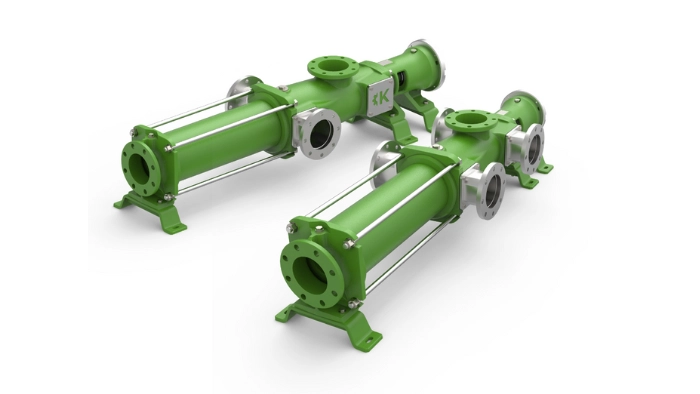
At Kronoa, we are the only progressive cavity pump manufacturer that equips its Premium Line with four large inspection ports: two on each side of the pump. Far from being a secondary feature, these ports offer multiple functional and operational advantages that directly impact installation time, maintenance efficiency, adaptability and process continuity.
What are inspection ports and why do they matter?
Inspection ports are access points built into the pump housing that allow direct visual and manual access to internal components such as the rotor, the drive shaft and the cardan transmission.
In Kronoa’s case, these ports are part of our Premium pump designs, and are large enough not only for inspection, but also for quick and safe intervention without disassembling the entire unit. In contrast, the absence of inspection ports is typically associated with block-type designs, common in many pumps on the market, where internal access is significantly restricted.
5 Key advantages of Kronoa’s four inspection ports
1. Easy access to rotor and shaft without full disassembly
Thanks to our inspection ports, you can easily reach the rotor and disconnect the shaft from the mechanical seal without having to dismantle the entire pump. This significantly reduces downtime during maintenance operations and simplifies interventions on-site.
2. Flexible flange positioning without rotating the pump body
Need a suction or discharge flange on the side instead of the top? With Kronoa, there’s no need to rotate the pump housing. Simply replace one of the inspection ports with a flange, reposition the cap, and you’re done. This flexibility saves hours of installation time and avoids mismatches during commissioning.
3. Multi-inlet Centralised Pumping System
The ports can also function as manifold inlets. This means you can transform the unit into a centralised suction pump, receiving fluid from multiple tanks (up to five entry points) and discharging through a single outlet. It’s an elegant solution for complex feeding systems without adding auxiliary pumps.
4. Visual inspection of the cardan transmission
When the pump behaves abnormally, strange noises, rotation issues, sudden stops, you need answers fast. Our inspection ports allow you to check for entangled fibres, hair or plant matter on the cardan joint and remove them manually if needed. The ports are large enough to allow direct access without tools.
5. Universal flange compatibility (ANSI + EN 1092)
All suction and discharge flanges, as well as inspection ports used as flanges, are drilled to match both ANSI and EN 1092 standards. This ensures full global compatibility, regardless of where your pump is installed or the connection system used on-site.
What happens when a pump has no inspection ports?
Most progressive cavity pump manufacturers still omit inspection ports from their designs. This leads to a range of limitations that impact both operations and maintenance:
- To change the suction or discharge direction, the pump body must often be rotated, and in many cases, it doesn’t align correctly, especially in tight layouts.
- For any internal maintenance, the entire pump must be disassembled, increasing labour time and process disruption.
- If there is a problem with the transmission, there is no way to inspect it without removing the pump from the line.
In short, not having inspection ports means less flexibility, more downtime, and higher maintenance costs.
Inspection ports are not an extra, they’re essential
At Kronoa, we design our pumps with the realities of industrial operations in mind. Our four large, functional inspection ports are not a gimmick, they are a deliberate, engineered solution to reduce maintenance times, enable faster installation, and adapt to any system configuration.
If your application demands uptime, flexibility and control, inspection ports aren’t optional. They’re fundamental.
Green future. Green heart. Think green.

Progressive Cavity Pump Installation, Service & Lifecycle Support: Why Kronoa is more than a pump supplier
Progressive Cavity Pump Installation, Service & Lifecycle Support: Why Kronoa

Progressive Cavity Pump Design for abrasive and high-solids fluids: engineering reliability into every component
Progressive Cavity Pump Design for abrasive and high-solids fluids: engineering

Wastewater infrastructure resilience: Redefining sludge handling in Northern Europe
Wastewater infrastructure resilience: Redefining sludge handling in Northern Europe Table