How mechanical pre-treatment improves Biogas Production efficiency
Case study: mechanical optimisation in a biogas facility
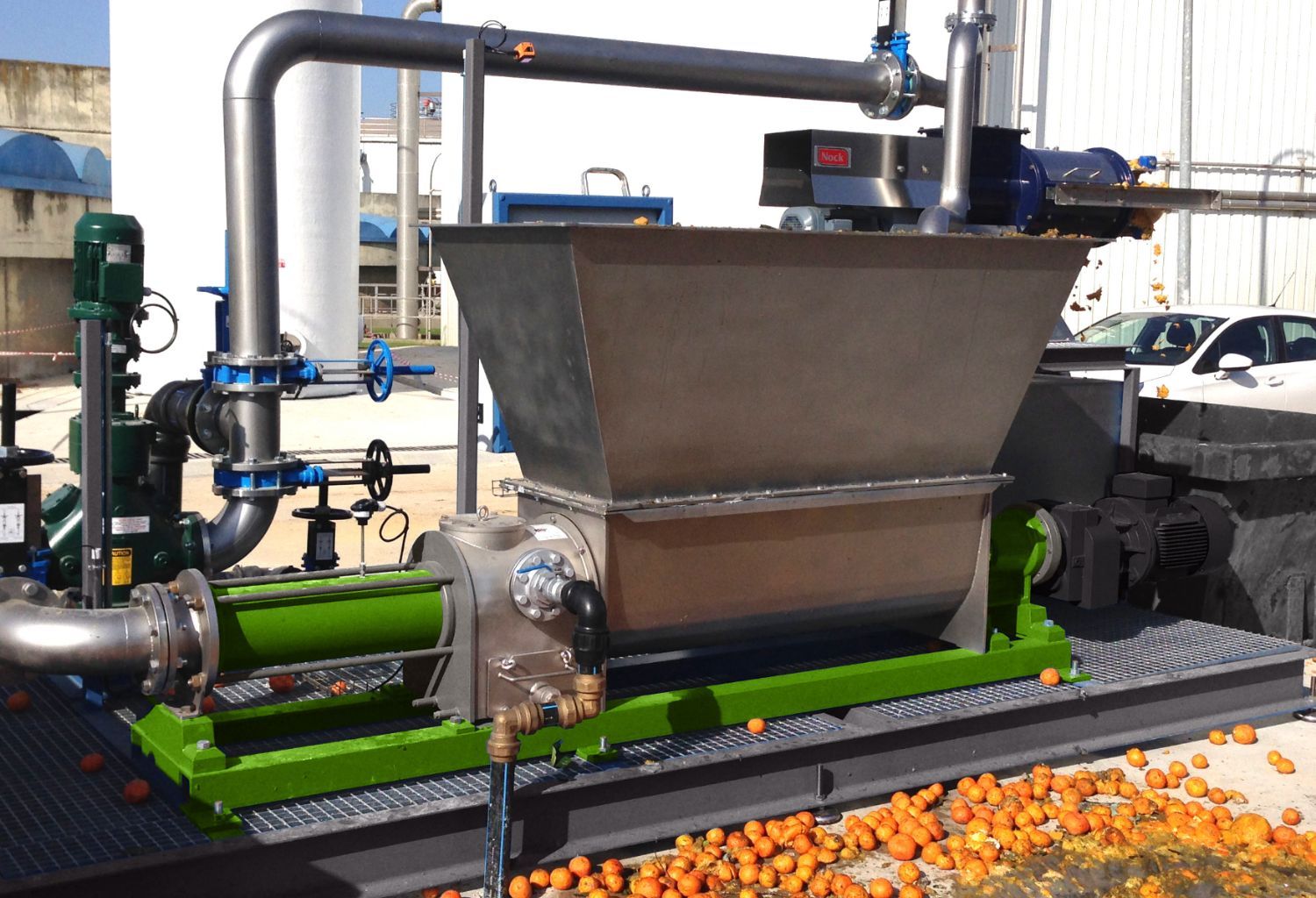
In a typical agricultural biogas installation, a combination of a Bio-mix pump and a grinder was used to optimise substrate preparation before digestion. While the exact layout can vary, this practical configuration highlights how upstream equipment plays a decisive role in enhancing biogas production under real process conditions.
At Kronoa, we support engineering teams in selecting and integrating progressive cavity pumps that work seamlessly with auxiliary systems such as grinders and mixers, especially when dealing with fibrous, high-solids or variable substrates.
Setting the system: Bio-mix with grinder and side feeding
In this setup, the mixer pump Bio-mix receives a mixture of organic matter and a water-like medium through the side inlet flange, while a grinder processes the material just before it enters the digester. Reducing particle size mechanically, through crushing, grinding or shredding, has a direct impact on biogas production.
Finer particles offer a higher surface-to-volume ratio, increasing microbial access and accelerating hydrolysis, the first and often limiting step in anaerobic digestion. During hydrolysis, complex organic matter (like carbohydrates, fats, and proteins) is broken down into simpler, soluble molecules (like sugars, amino acids, and fatty acids). It is often a rate-limiting step, especially when large or fibrous particles are present (like straw, grass, or manure).
Microorganisms such as bacteria and archaea break down the material more efficiently, which leads to faster digestion, earlier biogas generation, and greater process stability. The crushed substrate also mixes more effectively inside the digester.
However, it’s essential to avoid over-grinding. Particles smaller than 1 mm can make the sludge too viscous, hindering proper mixing. It’s also important to consider the energy cost of grinding, and whether the gain in biogas production justifies the consumption. For fibrous materials, mechanical reduction combined with pretreatment can improve breakdown further.
Conditions that favour high biogas production
Once the substrate is properly prepared, several characteristics influence its digestibility and the resulting gas yield. High organic content, rich in carbohydrates, proteins and fats, is ideal. Food waste, manure, energy crops and some industrial residues meet this profile. In contrast, untreated woody biomass contains lignin, which is difficult to degrade and should be avoided unless pre-treated.
Particle size should ideally be between 1 and 10 mm. This range balances microbial access with manageable viscosity. Homogenising the input material before it enters the digester ensures uniform feeding and prevents operational issues like clogging or layering.
Feeding strategy also matters. Continuous or semi-continuous input keeps microbial activity stable, supporting a consistent biogas production rate over time. Batch feeding can create fluctuations that reduce process efficiency.
Maintaining digester stability
Stability inside the digester is fundamental. Microbial activity performs best in a pH range of 6.8 to 7.4. Most facilities operate in mesophilic conditions (35–40 °C), which are stable and reliable. Thermophilic digestion (50–57 °C) can increase breakdown speed and pathogen reduction, but is more sensitive to changes and requires tighter control. Sudden temperature variations should always be avoided, as they disrupt microbial communities.
Operators must also monitor for inhibitory compounds. Excessive levels of heavy metals, salts, antibiotics, ammonia (above 3,000 mg/L), or sulphates can negatively affect biogas production. These elements should be minimised during substrate selection and pre-treatment.
Mixing strategy and process integration
Adequate mixing ensures the uniform distribution of nutrients and microorganisms, preventing scum formation and sediment accumulation. Over-mixing, however, can be counterproductive, as it may disrupt microbial colonies and compromise efficiency. The goal is controlled, consistent mixing adapted to the characteristics of the feedstock.
Optimising biogas production as a system
This practical example illustrates how upstream equipment, substrate selection and operational control must work together to achieve consistent and high-yield biogas production. Mechanical pre-treatment, when correctly applied, creates favourable conditions for microbial activity and digestion efficiency.
At Kronoa, we help engineering teams define the right pumping, feeding and integration strategies for each process scenario, ensuring that the equipment adapts to the needs of the process, not the other way around.
Green future. Green heart. Think green.

Progressive Cavity Pump Installation, Service & Lifecycle Support: Why Kronoa is more than a pump supplier
Progressive Cavity Pump Installation, Service & Lifecycle Support: Why Kronoa

Progressive Cavity Pump Design for abrasive and high-solids fluids: engineering reliability into every component
Progressive Cavity Pump Design for abrasive and high-solids fluids: engineering

Wastewater infrastructure resilience: Redefining sludge handling in Northern Europe
Wastewater infrastructure resilience: Redefining sludge handling in Northern Europe Table